Flute of Priests and Poets
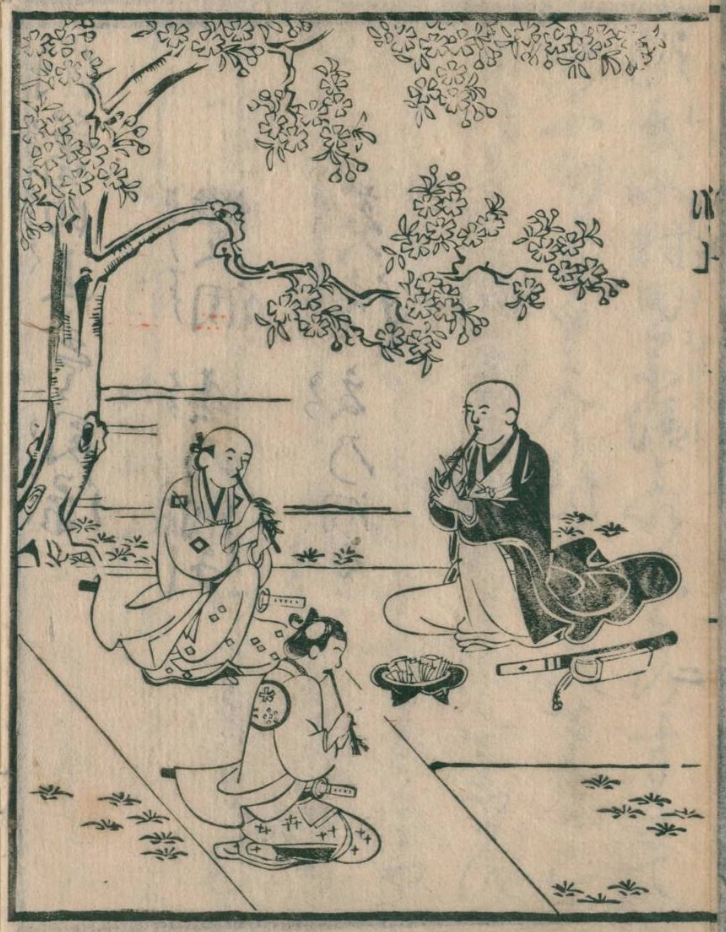
Hitoyogiri shakuhachi (in its time referred to simply as “shakuhachi”) pieces were birthed, it seems, in a context of religion / philosophy and poetry. Friends (usually of the elite class, somewhat in contrast to the Fuke shakuhachi, whose players, though samurai, were often outcasts or of ill repute) would gather at various temples to share drinks, poetry, and often shakuhachi playing as well. Take this record from Rokuon Nichiroku, the temple manager’s diary from a Rinzai Zen temple:
21 August, 1596 Just after noon, Nanbo and Joei-ji, along with two priests and ten other people came. Sokun played shakuhachi. Our ears were fully satisfied with its unhurried, boundless sound. In the evening we started drinking sake. We ate chicken eggs. Yuzo came. Brought 10 matsutake mushrooms.
The “Sokun” above refers to Omori Sokun, who is responsible for organizing and revitalizing the (hitoyogiri) shakuhachi, without whom we would have virtually no information about how to play. Thanks to his score collections and commentary, we can go quite far in bringing these pieces back to life.
One of his teachers, Yasuda Jocho, was a Pure Land priest, who not only wrote the piece Yasuda, but also taught Sokun concerning much of the connection between hitoyogiri and Yin / Yang philosophy. The repertoire is distributed over five modes, which are all played on a single flute (the standard being Oshiki / A); each mode is classified as Yin or Yang, and the characteristics of its tones and techniques change according to the yin and yang aspects of the seasons. Similar to the way haiku poems came to incorporate a “season” word, these pieces reflect a poet’s mindset, paying attention to the changing colors and activities of the seasons, and reflecting these in the flow between the five tones of each mode.
Sokun’s school of shakuhachi was one of several. Some other Pure Land Buddhist priests seem to have had their own ways to play the classical pieces, but Sokun was the inheritor of Sosa-ryu, started a few generations before his time by a man named Sosa. We know little about him, but Sosa left behind a small collection of tanka poems that convey his shakuhachi teaching philosophy. For example:
尺八と 太刀の手立の 心持 ひかえてきるに その利有りけり
The way to wield your mind when playing shakuhachi is the same as when using a tachi: “Not too much.” This is indeed beneficial.
The tachi a type of katana; wielding it requires one to be attentive yet relaxed. If you tense up and try too hard, you end up being on the losing end. It’s not a performance; and besides, if you really want to hold on to your life, paradoxically, if you grasp it too tightly, you end up losing it. His approach to shakuhachi is the same. We can see this attitude again reflected in the next poem:
音のなまる ことを心に 思へただ 息押し付けて 吹し故なり
You get distracted with your sound being off - because you’re playing by forcing in your breath.
Playing shakuhachi requires listening. If you try too hard to be in control, your sound will lack depth and soul. Listen, and find where the bamboo wants to resonate - then you can play a rich sound with very little breath and almost no effort. On the other hand, if you force in your breath in a one-sided attempt to make the bamboo obey your commands, you’ll find that the shakuhachi responds weakly, like one acting under compulsion.
There were players before Sosa as well, as far back as the 1400’s and perhaps even a little earlier. We know of Ikkyu, of course, and also a players like Mon-ami (a Pure Land priest who wrote Kochigo) and Ton-ami. Many sources identify the latter as the famous poet Ton’a, as I wrote in the last article, but this may be a mistake for a shakuhachi player and maker of the same name, who lived a bit later on. One of Ton-ami’s flutes was acquired by a samurai / poet named Socho, who wrote about it in his diaries in the early 1500’s. Socho also writes about other shakuhachi encounters - for example, in 1524, he writes about an 80-year old priest leaving a lasting impression by playing only two brief Hyojo (Autumn mode) pieces. He later writes again about the same priest: “While composing renga, he told us stories late into the night, then played shakuhachi in a way that made both joy and longing sink deeply into me.”
And so we see again that the hitoyogiri shakuhachi was not so much used for public entertainment as it was for contemplation or sonic poetry, as an aspect of deeper communication between friends. I’ll leave you with a final poem by Ikkyu, quoted in Omori Sokun’s treatises:
なかなかに、 我に如かざる 人よりも、 ただ尺八の 音こそ友なれ。
The only friend who really seems to understand me is the sound of my shakuhachi.
And finally, a shameless plug. I’d be delighted to have you join me to learn Shin Sosa-ryu Shakuhachi (hitoyogiri). You can get in touch with me at https://www.hon-on.com/lessons.html.