Kamiya Juntei
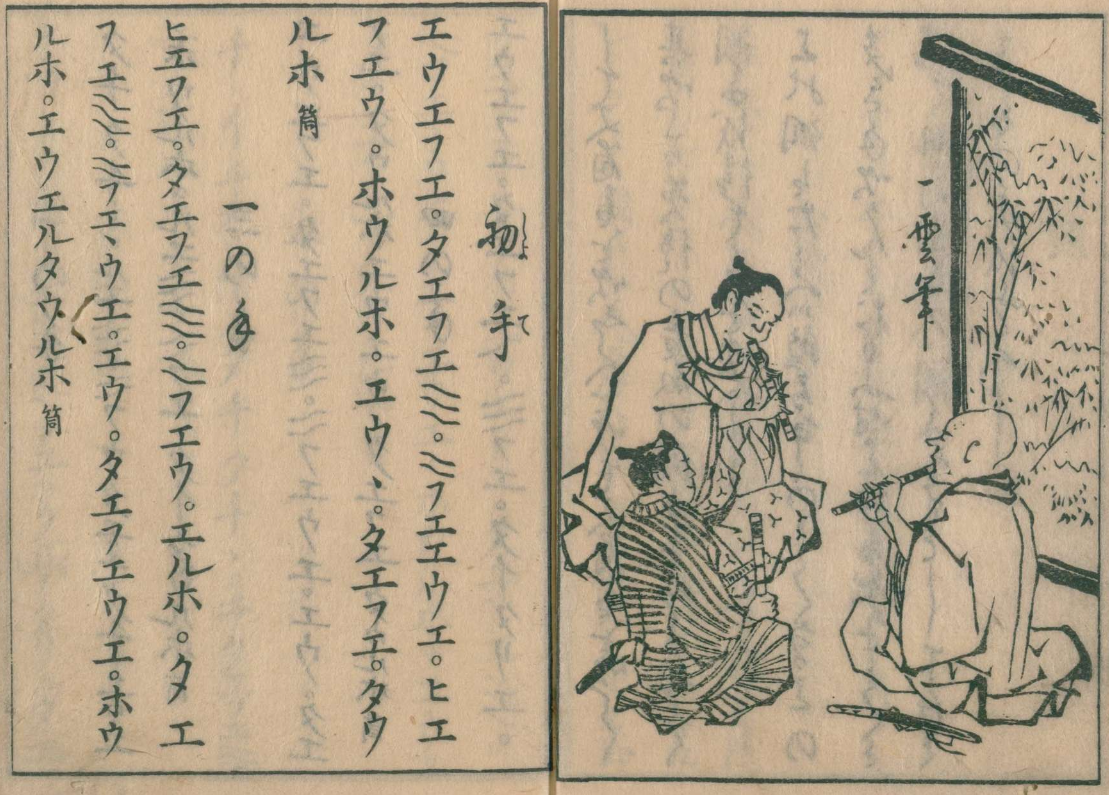
It’s 1818, in latter Edo period Japan. Inou Ichi-un, student of Kamiya Juntei (bamboo name Isshi-an) has been hounded for some time by a publisher to release his teacher’s book (the one he had been “carrying around in his kimono sleeve”) for publication, and finally agrees. Shichiku Kokin-shu: Strings and Bamboo, Then and Now, goes to press.
From the publisher’s point of view (as written at the end of the book), it almost seems as if the author, Kamiya Juntei, didn’t even want to publish his book, entrusting it only to his head student. When we read it, however, we see the story of someone who was eager to breathe new life back into the hitoyogiri tradition, which at the time was in danger of extinction. The medieval music theory of the Muromachi era had become increasingly obtuse to modern ears as the newer miyakobushi scale pervaded the popular musical landscape, and players were becoming increasingly rare.
Nonetheless, there were still some left in the Sashida-ryu hitoyogiri tradition. Sashida-ryu was started by Sashida Ichi-on as a branch of Sosa-ryu shakuhachi, taking Omori Sokun’s Kyoto-based work that popularized the flute in the early 1600’s and (through his successor Sashida Chikuden) popularizing them in the city of Edo (Tokyo). While the tradition was still mostly intact in Kamiya’s time, it was evidently a dying art. His book lacks some of its finer points and nuance; whether these had simply been lost to time or were deliberately omitted in an attempt to make the pieces more accessible is difficult to say.
Regardless, Kamiya (a doctor by profession) learned Sashida-ryu hitoyogiri from his uncle Yana Tsugimasa of the Nakazu domain in Kyushu, who may have studied with Maeno Ryotaku or one of his students. Maeno Ryotaku was a physician living in Nakazu; in the early to mid 1700’s, he had been encouraged by his adoptive father to study and preserve the hitoyogiri as it was even then a gradually dying tradition. Kamiya Juntei likewise hoped to preserve it.
Kamiya’s book Shichiku Kokin-shu begins with an introduction to a smattering of classical Muromachi-era pieces, written to reflect his own style. The phrasing is somewhat unique, differing from earlier Sashida-ryu scores, and the kaeshi formulae used to end pieces are often simplified. Detailed explanations as in earlier manuscripts are omitted, with the written caveat that to play them properly, you still need a teacher.
After introducing the classics, he writes to the effect that since these older pieces are difficult to learn for “modern” people, he has rebranded the hitoyogiri as kotake (little bamboo). He composed new “classical style” pieces for it, changing the notation, and also wrote down numerous ensemble pieces, including Rokudan. His hope was that “if you are able to [start by] playing these pieces, the elegant pieces of old will perhaps become more accessible to you.” These sixteen unique pieces have a miyakobushi flavor, and don’t follow medieval music theory (or even Fuke shakuhachi conventions, for that matter). After these, he adds several ensemble pieces, including the well-known Rokudan, concluding with an explanation of how to match the hitoyogiri to standard shamisen tunings.
Judging from the fact that we still have many copies of this book in existence, it would seem that it was somewhat of a success. Kamiya also published Shichiku Goshikigai, comprising nearly 100 pages of popular (?) pieces transcribed for the kotake, along with other books on the history of hitoyogiri and the philosophy of kotake. In spite of the book’s success, in the end, the tradition still died out. By the end of the Edo era in the late 1800’s, it appears that no one living knew how to play. In fact, many shakuhachi players in the mid to late 1900’s mistakenly thought that Kamiya’s Kotake compositions (Satori no kyoku, Mushi no ne, etc.) were actually ancient hitoyogiri pieces - if nothing else, this is a testament to Shichiku Kokin-shu having been prolific enough to have been relied upon, albeit erroneously, many generations later.
Shichiku Kokin-shu is not the best representation of the classical Sosa-ryu (which branched off into Sashida-ryu) hitoyogiri pieces, but because of its simplicity, clarity, and accessibility, it provides a very nice introduction. At the same time, Kamiya’s attempt to use “contemporary” pieces as an inroad to the classics, while interesting, was ultimately unsuccessful. The hitoyogiri is made for playing medieval pieces, rather than late Edo-era ensemble music. Its tonal simplicity and flexibility make it perfect for playing these elegant predecessors to Fuke shakuhachi, which though differing somewhat in theory contain all of the power of that philosophical/meditative approach that the latter retains. While playing modern pieces, or even Rokudan, on a hitoyogiri is possible, it feels kind of like hammering in a nail with the butt of a screwdriver. You can do it, but why would you want to when a hammer works so much better?
Nevertheless, I don’t know that anyone could have done better. Muromachi-era hitoyogiri pieces are an immersive monophonic expression of the moment, using medieval tonal behaviors shared with Shomyo chant, Gagaku, and Noh music. They may not be for everyone, but now that the audience isn’t limited to Kyoto or Edo, we can perhaps continue to breathe new life into these old pieces.
If you want to learn these medieval hitoyogiri pieces, I lead classes online - $50 for four sessions per month. All skill levels are welcome - see www.hon-on.com/lessons.html for more info. For an English translation of Shichiku Kokin-shu, see www.hon-on.com/other.html.
Kamiya Juntei’s Hitoyogiri, Shukai
The gold maki-e characters seem to read Shu 秋 (Autumn) Kai 海 (Ocean); the additional character by the finger hole appears to be Yana 梁. You can also see Kamiya’s stamp Isshi 一思 in three locations on the flute. The appearance of the name Yana suggests that he may have made this flute for his uncle or another family member.