Roots of the Hitoyogiri Shakuhachi
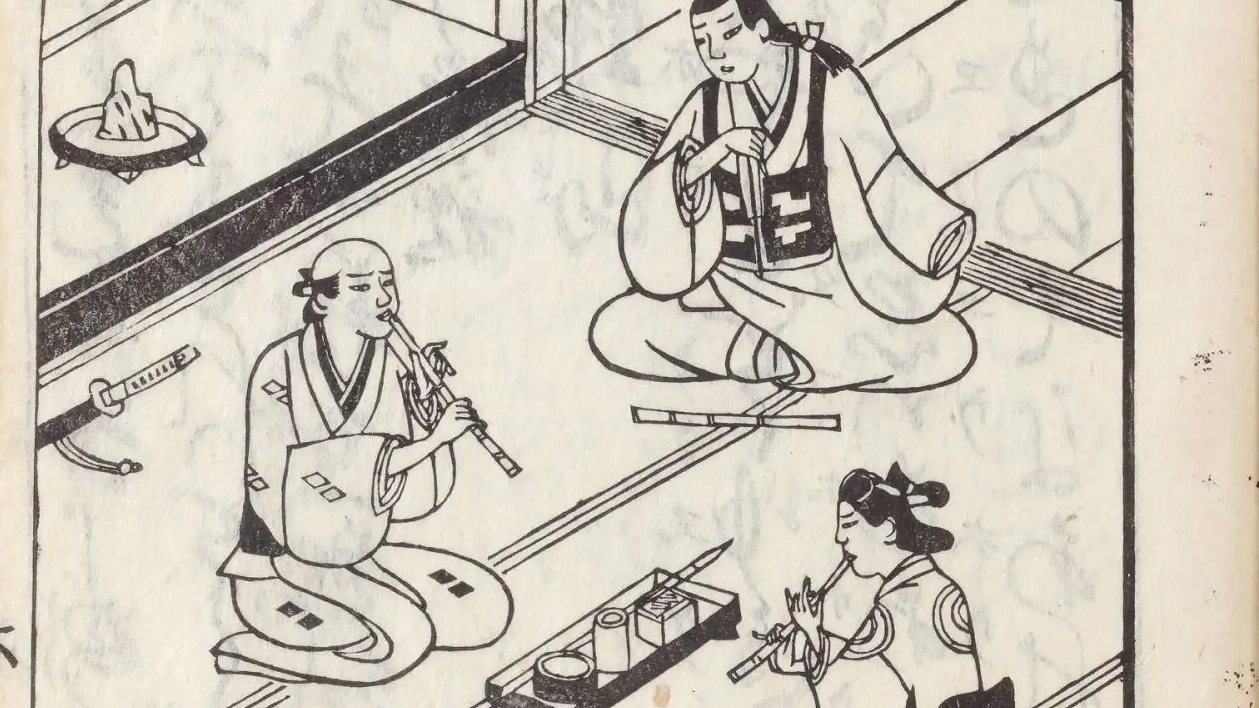
Up until the mid-1600s — when the longer Fuke shakuhachi gained popularity — when someone said “shakuhachi” they were usually referring to what we now call the hitoyogiri. A short flute of about 1.1 shaku, it has only one node (hito yo) and five holes, which yield tones slightly different from those of the Fuke shakuhachi of the Edo period. In ancient manuscripts it is also called tanteki (short flute) and dōshō (from the Chinese dong xiao). The dōshō was originally about 1.9 shaku, with six holes, and may have been called “shakuhachi” on account of its length (1.9 of earlier generations was equal to what we know of today as 1.8). One document, Gayū Manroku — an illustrated encyclopedia of the arts written by Ōeda Ryūhō in 1755 — says:
It is rare to find someone who knows of what we call the dōshō. It is long and thin, with a delicate sound. While the dōshō itself has been passed down, its music and playing technique have not. In today’s world, what we call the hitoyogiri should be understood as a variant of the dōshō. Of old it was called the shakuhachi … but now there is a long, fat flute commonly called the shakuhachi. It is used together with the sangen [shamisen], and thus its technique is corrupt and its sound is vulgar.
Ōeda does two things here. First, he says that what was originally shakuhachi is now called hitoyogiri in order to distinguish it from the newer, larger shakuhachi. Second, he separates the hitoyogiri from the secular world of entertainment — in this case, bar songs played with shamisen. Playing bar songs is of course not the stated purpose of the Fuke shakuhachi either, but it would seem that some players made time for such activities. Regardless, the author’s point is that the hitoyogiri shakuhachi was closer to the domain of religious music: that which seeks to connect the seen and unseen worlds, uniting the heart with the way of heaven.
He continues to give us examples from history. “In Tosai Zuihitsu [a collection of essays from the late 1400s], it is said that Jikaku Daishi [a.k.a. Ennin, a Tendai Buddhist priest, d. 864], during a period when his voice couldn’t produce enough volume, instead used a shakuhachi to intone the Amida Sutra.” I’m unsure, however, how he knows that this was a hitoyogiri shakuhachi, and not a dōshō or gagaku shakuhachi, since the latter two are potentially older and share the same name.
Either way, it’s of interest that Jikaku was using a shakuhachi to intone the Amida Sutra. In his time, Pure Land Buddhism hadn’t yet developed, but its roots were already present in Tendai Buddhism. Later, in the Kamakura era, Hōnen (d. 1212) founded Pure Land Buddhism, centering around veneration of Amida Buddha. Notably, Pure Land chant employs the same ritsu and ryo modalities as the hitoyogiri. It’s also around this era that we begin to encounter more historically verifiable hitoyogiri players — many of them being Pure Land monks, with some Zen monks and aficionados, not to mention poets, sword makers, and other artists in the mix as well.
The first that I’m aware of is Ton’a, a Pure Land monk and poet (1289–1372). He is credited in the earliest hitoyogiri score collections with composing the piece Korobi. His shakuhachi, bearing a maki-e inscription reading 老人 (Oibito, “Old Man”), makes an appearance in Sōchō’s journals. Sōchō (1448–1532) was a samurai and renga poet — think collaborative tanka poems — who, though he didn’t play shakuhachi himself, frequently heard it played by friends and acquaintances, one such instance being at a memorial for Ikkyū Sōjun, another hitoyogiri-playing Zen monk and poet, who had passed away a few decades earlier. Sōchō, at one point, records having acquired the Ton’a Oibito shakuhachi. The flute also appears in a mid-Edo-era catalog of historical items, and still remains in storage today at Saioku-ji, a temple once frequented by Sōchō.
Addition: after writing this article, it became clearer that the Ton’a referenced was a different person with the same name (Ton’ami). Ton’ami was a musician living in the mid-1400s, and while at least loosely affiliated with a Pure Land sect, he was not a priest like the former Ton’a. The reason for the confusion is that Ton’a was very well known, and later Edo-era documents, including Gayū Manroku, mistake the earlier, more well-known Ton’a for the later Ton’ami who played and composed classical hitoyogiri shakuhachi pieces. Regardless, it remains difficult to pinpoint a specific start date for the hitoyogiri as a flute, as well as the classical repertoire associated with it, but we can say that the classical pieces in some form date back at least to the 1400s, and the flute itself dates back at least to Ikkyū’s time in the late 1300s, but likely existed before that as well. Now, back to the main article:
The last anecdote in Gayū Manroku is quoted from Yoshino Shūi, a collection of stories written around 1358. This reports that Tsukushi no Miya (d. 1346), son of Emperor Godaigo, during his youth, “obtained a shakuhachi, and came to play it with a heaven-born skill, evoking a sense of mystery. When he played for the Emperor on a visit to Yoshino, a great number of unusual fish danced up out of the water, causing a marvelous sensation that was unparalleled.” Ōeda goes on to note that although some claim Tsukushi no Miya as the founder of the classical school of hitoyogiri shakuhachi, this is false, as Jikaku was already playing it long before. I’m not sure if this is provable, but regardless, with known players like Ton’a, Tsukushi no Miya, and Ikkyū Sōjun active around this time, we can say that the classical style of hitoyogiri dates back at least as far as the mid-1300s.
Thus we have the first element of our background: the hitoyogiri shakuhachi was played primarily by Pure Land and Zen monks, as well as samurai and poets. Its pieces were used not for musical entertainment, but rather for personal and mutual edification, as a meditative practice — like sonic poetry shared among friends while discussing religion and philosophy. In the next installment, we’ll dive a little deeper into the lives of some historical hitoyogiri shakuhachi players to learn more about their approach to playing.
Nick Bellando, after quite a bit of research, has founded Shin Sosa-ryu Shakuhachi, a school of classical hitoyogiri that revives the ancient tradition of Ton’a, Ikkyū, and others. If you want to learn the hitoyogiri shakuhachi as played by monks and poets of ancient Japan, visit hon-on.com/lessons to sign up, or contact him with any questions.
Article published with the permission of Nick Bellando.